

OASIS+ 101:
A Practical Guide for Contractors Ready to Compete Smarter
For many federal contractors, GSA’s One Acquisition Solution for Integrated Services Plus (OASIS+) contract vehicle occupies an uneasy intersection of promise and uncertainty. Widely recognized as one of the government’s most powerful professional services contract vehicles, OASIS+ is also frequently misunderstood, pursued prematurely, or viewed more as a prized credential than as the foundation of a sound growth strategy. Time and again, we encounter teams who know they “should” care about OASIS+ but lack a clear understanding of what it truly takes to compete, and succeed, once on the vehicle.
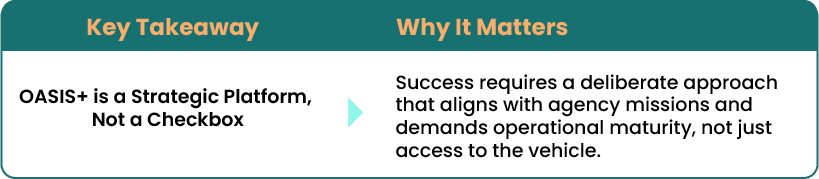
At BTW & Co., we believe OASIS+ is far more than a box to check or a milestone to achieve as quickly as possible. Instead, we approach it as a strategic growth platform. When leveraged with discipline and intent, OASIS+ can accelerate access to mission-critical work, streamline procurement timelines, and fundamentally reshape how agencies engage with contractors. Conversely, a reactive approach to OASIS+ often exposes systemic weaknesses, hindering growth rather than enabling it.
This article aims to cut through the noise and offer a clear, actionable understanding of what OASIS+ is, how agencies use it, and the critical factors contractors should weigh before pursuing it.
What is OASIS+?
OASIS+ is GSA’s latest governmentwide, multiple-award indefinite delivery, indefinite quantity (IDIQ) contract vehicle, specifically designed to support complex professional services requirements that cross multiple functional disciplines, rather than remaining confined to a single technical area. The contract’s structure enables agencies to procure integrated and multidisciplinary solutions, ranging from management consulting to engineering and logistics, efficiently and flexibly.
The most important aspect of OASIS+ is not simply its acronym or its contract mechanics, but the agency intent behind its creation. OASIS+ was developed to make it easier and faster for agencies to access best-in-class, integrated professional services, eliminating the need to reinvent the procurement wheel for each requirement. Program offices turn to OASIS+ when they need partners capable of bridging boundaries, managing complexity, and delivering measurable outcomes—not just isolated tasks.
OASIS+ builds on the legacy and lessons of previous OASIS vehicles, consolidating and modernizing several earlier contract families and supporting both unrestricted and small business pools. While the vehicle’s structure and scope have evolved, agency expectations have remained consistent: speed, regulatory compliance, disciplined pricing, and proven delivery capability.
Why Agencies Lean on OASIS+
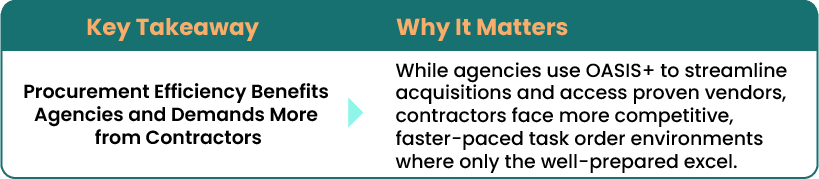
Agencies turn to OASIS+ because it removes friction from the procurement process. Rather than initiating lengthy, full-and-open competitions, contracting officers can issue task orders directly to a pre-vetted pool of vendors that have already demonstrated baseline technical capability and responsibility. This streamlined approach accelerates acquisition timelines, reduces administrative burden, and focuses on mission outcomes.
For contractors, this changes the nature of competition. Task orders often move quickly, timelines compress, and the margin for error shrinks. The competitive emphasis shifts from proving basic eligibility to demonstrating readiness, clear differentiation, and strong execution under pressure.
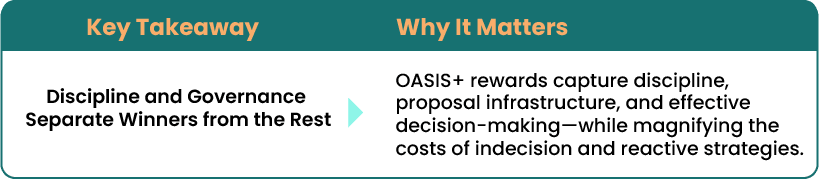
This is where many organizations misjudge the vehicle’s demands. OASIS+ is not forgiving. It rewards teams that already have mature capture discipline, proposal infrastructure, and decision governance in place. It magnifies the cost of indecision, disorganization, and reactive pursuit behavior.
The Myth of OASIS+ as a Growth Shortcut
One of the most persistent misconceptions about OASIS+ is that holding a spot on the vehicle guarantees growth. It does not.
OASIS+ does not replace business development. It does not solve pipeline quality issues. And it does not compensate for weak capture strategy or overextended proposal teams. In fact, it often accelerates burnout for organizations that mistake access for readiness.
We also see firms assume that OASIS+ is only viable for large systems integrators. In reality, many small and mid-sized businesses win meaningful work through OASIS+. The difference is not size, it is posture. Successful firms enter OASIS+ with a clear position, disciplined pursuit selection, and capacity to execute repeatedly without exhausting their teams.
What It Means to Be OASIS+-Ready
OASIS+ readiness is not about having the right NAICS codes or checking compliance boxes. It is about whether an organization can operate effectively in a high-velocity, task-order-driven environment.
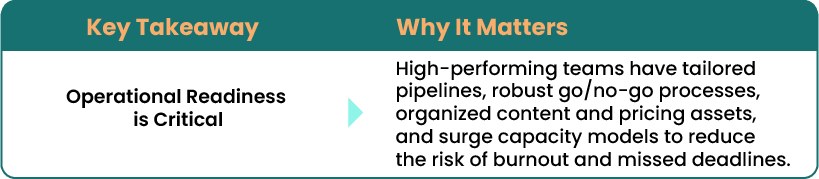
Teams that perform well on OASIS+ tend to share a few characteristics. They have pipelines that are aligned to specific buyers and missions, not generic opportunity lists. They use structured go/no-go processes to protect their teams from chasing unwinnable work. They maintain clean, centralized content libraries and pricing assets that support rapid response. They have surge capacity models that allow them to flex without burning out core staff. They have surge capacity models that allow them to flex without burning out core staff. In addition, they invest in training, so roles are clear and execution is not dependent on individual heroics or last-minute firefighting.
Organizations that struggle with OASIS+ are rarely short on talent. They are short on systems.
Prime or Partner: Choosing the Right Path In
Another critical decision point is how to enter the OASIS+ ecosystem. Not every organization should pursue OASIS+ as a prime contractor on day one.
For many firms, the smarter move is to enter as a strategic teaming partner. This allows teams to learn how agencies use the vehicle, build task-order past performance, and mature internal processes without absorbing the full operational burden of priming. Over time, partnering can become a deliberate steppingstone toward prime readiness.
Prime status on OASIS+ should be earned through experience, not ambition alone. The vehicle does not reward organizations that skip foundational growth steps.
How BTW & Co. Supports OASIS+ Success
At BTW & Co., our role is not simply to help teams respond to OASIS+ task orders. We help organizations build growth operations designed to succeed on vehicles like OASIS+.
We help shape pipelines around realistic opportunity sets, implement decision governance that matches task-order velocity, and modernize proposal environments with human-led, AI-enabled workflows that prioritize both speed and compliance. In addition, we help organizations implement surge capacity models to protect their core teams, and we design training programs to ensure that capture, solution, and proposal leaders fully understand growth processes and their roles and responsibilities.
OASIS+ success is rarely about a single bid. It is about repeatability. Our work is focused on helping clients compete with confidence, consistency, and sustainability over time.
The Bottom Line
OASIS+ is not an on-ramp for organizations that are almost ready. It is a force multiplier for organizations that are.
When pursued with discipline, it can unlock sustained federal growth and deeper agency relationships. When pursued reactively, it tends to expose every structural weakness in a growth system at once.
The difference is preparation.
Ready to Evaluate Your OASIS+ Readiness?
If you’re considering OASIS+, whether as a prime or a strategic partner, the most valuable first step is clarity. A readiness conversation now can prevent costly missteps later.


