

The GovCon AI & ROI Series
Why AI investments underperform in federal proposal shops
Anyone in federal contracting leadership or ownership has heard the AI pitch by now. “AI will revolutionize your proposals.” “AI will cut your timeline in half.” “AI will make your team more efficient.”
Plenty of leaders have already bought in. They purchased the tools, had their teams run the pilots, and they generated proposal content. But, was it any good?
Shortly after AI implementation, growth teams report back to their executives with remarkably consistent complaints: “The AI isn’t working as promised.” “The output doesn’t sound like the company.” “It missed compliance requirements.” “It created more work than it saved.” When renewal comes up, leadership cannot validate the investment in terms of proposal wins, regardless of how many more proposals were submitted.
The problem is rarely the technology. It is the foundation beneath it.
Foundation Failure: Implement then organize
Leadership sees a demo. The vendor shows a demo where a seemingly “red-team-review-ready” technical approach is automatically generated in about fifteen minutes. That used to take three days, at least! Leadership is sold: “We can do more proposals faster!” The direction comes down to the growth team: “Buy this tool, move fast.”
In the first iterations after the vendor-led pilot, the team begins feeding RFP requirements into an AI platform. Regardless of the prompts, the output is too generic and does not reflect the company’s actual approach, and/or the AI hallucinates. It creates compliance gaps and validity concerns that require human rework. The proposal manager ends up spending more time fixing AI-generated content than they would have writing the section from scratch.
The cost of the platform is visible and traceable. The cost of the labor for rework is not, and neither is the client risk exposure created when unverifiable claims reach a final proposal submission.
When content is scattered across SharePoint, hard drives, and old proposal folders, and processes shift from one pursuit to the next, AI doesn’t fix the mess. It multiplies it. The organization moves faster without moving smarter, and the team grows more frustrated, not more efficient. The tools and the people using them cannot be effective if the knowledge foundation they draw on is incomplete, out of date, or mismanaged. The AI investment becomes a sunk cost, but who is paying the price?
Organizations seeing real gains, in terms of proposals won, start with organized infrastructure. They focus on readiness first, then they bolt on the AI.
Foundation Success: Knowledge, Workflows, Policy
AI readiness is not just about adopting the latest tools. It is about building the three foundations those tools will require for your team to be effective using them:
- Organized knowledge management.
If a company does not know where its strongest technical content, institutional knowledge, and past performance references are stored, AI may not find them either. Without a single source of truth for corporate knowledge, AI will likely invent details or use outdated data to produce a requested output that “sounds good” but is probably not relevant, accurate, or even appropriate for the client. - Clear processes and workflows.
Your team needs to know when AI can help and when it should be avoided. Without clear processes, every team member invents their own way. That produces inconsistency, compliance risk, and wasted effort. - Defined roles and AI policy.
Not all AI use is equal. A capture lead applies AI differently than a solution architect. A proposal manager needs different AI functionality than a technical writer. An AI Governance Policy has to establish the guidance and understanding of the most appropriate and secure uses of AI within the organization.
Foundation Value: Excellence then AI
AI readiness is not technology adoption. It is operational excellence.
The work required to become AI-ready (i.e., organizing knowledge, documenting processes, defining clear roles) improves an organization whether or not it ever deploys AI. Centralized content makes proposals more consistent. Documented workflows make teams more efficient. Clearly defined roles mean handoffs work and quality does not drop between actions.
AI becomes the bonus, not the goal.
Where to start
AI is being applied to federal contracting whether any individual firm is ready or not. The question is not whether adoption happens. It is whether it happens strategically and efficiently or reactively and chaotically.
The organizations that build the foundation before deploying the tools will hold a competitive advantage. The ones that skip it and race right to the tool will burn resources, frustrate their teams, lose just as many bids, and wonder why AI never delivered on its promise.
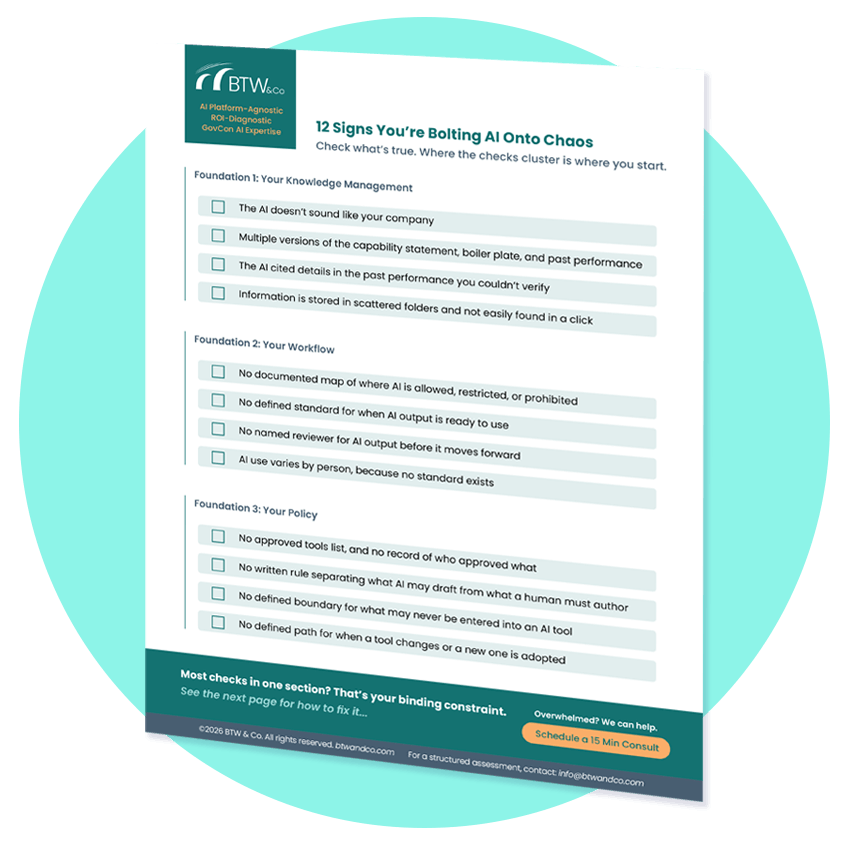
Diagnosing where to start requires an honest inventory of what is true for your company today — which, as BTW & Co. has discovered, most teams have never actually sat down and done. We put together a self-guided diagnostic 12 Signs You’re Bolting AI Onto Chaos, to help identify your company’s AI Readiness priorities before you invest in tools that perpetuate chaos. With a few quick clicks, you can better understand where your team stands with the three foundations — with clear, actionable next steps to take.

Organized Knowledge, Clear Processes, and Defined Roles are Essential for Maximizing AI
For teams working on any of these three foundations, BTW & Co. offers AI Readiness for Federal Growth, a four-part professional development course covering knowledge management infrastructure, AI workflow integration across BD, capture, solutioning, and proposals, and the parameters of a foundational AI policy, with practical application of models and tools for each.


